
Poetry thoughts and ideas. What I'm reading, what I'm writing and the bits of my life that fall in between
Wednesday, February 27, 2008
One Line Lichen and Winter Trees

Sunday, February 24, 2008
Wednesday, February 20, 2008
Friday, February 15, 2008
One Line Richmond Park, dawn, frost and mist

Wednesday, February 13, 2008
One Line

Saturday, February 09, 2008
One Line

Saturday, February 02, 2008
Uncle Vanya at The Rose Theatre, Kingston

We went to the new Rose Theatre in Kingston this evening to see Chekhov's Uncle Vanya - the first production in the new theatre.
It was the usual ingredients of declining Russian middle class, haunted by the meaninglessness of life, filled with unfulfilled longing.
Suffused with a hint of peasant, an alcoholic stupor and a rant about the decline of the Russian forest.
Laced with tragic foreboding and dark ironic humour.
All done very well. Peter Hall directed an impressive cast.
Sunday, January 20, 2008
Sermon Sunday 20 January 2008 8.0 Holy Communion
This is the third sermon I've been invited to give at Christ Church. The service is a 8 O'clock Holy Communion service. It uses the book of Common Prayer 1662. I love the service. It has no songs or hymns. Just the liturgy, the readings, sermon and communion. There are usually no more than 25 people present and this gives an intimate and reflective atmosphere.
It takes me a long time to put together a sermon. I start preparing for it when I get given the date and the reading - about 6-8 weeks before the service. And I try and spend some time every day working on it from then on. In the last 3-4 weeks I try and spend an hour a day on it.
Hope you enjoy it.
Love David
Reading Matthew 20:1-16
The Parable of the Workers in the Vineyard
1"For the kingdom of heaven is like a landowner who went out early in the morning to hire men to work in his vineyard.
2 He agreed to pay them a denarius for the day and sent them into his vineyard.
3"About the third hour he went out and saw others standing in the marketplace doing nothing.
4 He told them, 'You also go and work in my vineyard, and I will pay you whatever is right.'
5 So they went.
"He went out again about the sixth hour and the ninth hour and did the same thing.
6 About the eleventh hour he went out and found still others standing around. He asked them, 'Why have you been standing here all day long doing nothing?'
7" 'Because no one has hired us,' they answered.
"He said to them, 'You also go and work in my vineyard.'
8 "When evening came, the owner of the vineyard said to his foreman, 'Call the workers and pay them their wages, beginning with the last ones hired and going on to the first.'
9 "The workers who were hired about the eleventh hour came and each received a denarius.
10 So when those came who were hired first, they expected to receive more. But each one of them also received a denarius.
11When they received it, they began to grumble against the landowner.
12'These men who were hired last worked only one hour,' they said, 'and you have made them equal to us who have borne the burden of the work and the heat of the day.'
13 "But he answered one of them, 'Friend, I am not being unfair to you. Didn't you agree to work for a denarius?
14 Take your pay and go. I want to give the man who was hired last the same as I gave you.
15 Don't I have the right to do what I want with my own money? Or are you envious because I am generous?'
16"So the last will be first, and the first will be last."
SERMON
Jesus came to turn things upside down. And our reading ends with Jesus’ saying “the first shall be last and the last shall be first.” The beginning of this chapter in Matthew is partly an illustration of this saying.
At the beginning of Jane Eyre by Charlotte Bronte Jane Eyre’s parents die and she is adopted by an aunt who mistreats her. The aunt spoils her own privileged children and sends Jane to a school for orphans, eventually she becomes a servant in a great house.
Yet at the end of the novel we find those that had treated her badly, despised her, abused her and rejected her have either died or their lives had been ruined. And Jane herself becomes the wife of the wealthy man she has loved for years.
For Jane Eyre “the first became the last and the last became the first.”
In the parable of the workers in the vineyard Jesus gives us a picture of what the kingdom of heaven will be like. He tells us of a vineyard owner going out into the market place and inviting men to work in his vineyard. Throughout the day he goes out to hire more and more people. And to each one he promises to pay them ‘what is right’.
At the end of the working day starting with those that have worked the least he pays them one denarius – a generous day’s wages for this unskilled work.
But those who had worked all day complained that it wasn’t fair. They had worked all day under the blazing sun not just one hour in the cool of the day!! But the vineyard owner protests, if he wants to be generous what is it to you what he does with his money?
It is in this openness, this outpouring of care and full hearted generosity that Jesus offers his disciples and us a glimpse of the kingdom of heaven.
You see behind the scenes the disciples have been arguing among themselves. Two chapters earlier in chapter 18 the disciples ask Jesus, “Who is the greatest in the kingdom of heaven?" And Jesus gives an astounding reply. “Unless you change and become like little children you will never enter the kingdom of heaven.” And later James and John’s mother asks Jesus “Grant that one of these two sons of mine may sit at your right and the other at your left in your kingdom.”
The disciples like the complaining vineyard workers expect honour, status and reward. They are measuring their work according to the values of men. But Jesus calls his disciples to be different. This call to be different is a key theme that runs throughout Matthew’s gospel. And I think this parable is an illustration to the disciples, showing them in what ways they are to behave and think differently in the world.
Because Jesus is not interested in status or hierarchy, he rejects this worldly way of looking at people. In fact he tells his disciples that far from expecting honour, they should seek to serve people. Later on in the chapter Jesus even says to his disciples that the greatest among you should serve you, the first among you should be your slave. He tells them that he has come to serve them, even to give up his life for them.
Jesus had come to turn the world upside down. This was a hard message for his disciples to grasp. And it is a message that we struggle with still, today.
He has no concern for earthly judgments or an earthly perspective. The complaints of the vineyard workers reveal their bitterness, their self importance and their jealousy and small mindedness. Jesus instead elevates those in society that are forgotten, the ignored, the unimportant and the unemployed. He is concerned with the ones left out, those hanging around the market place – a Judean job centre - with nothing to do and nowhere to go. In this parable he echoes The Beatitudes, encouraging his disciples to look with God’s eyes at our world and not with the eyes of the Romans or the Pharisees.
And this is still a challenge for all of us today, for me today. For who do you think you are in this parable? I know who I am. I am one of the vineyard workers whose been working all day. And sometimes I look at the world around me, and I am filled often with jealousy or bitterness.
In this parable Jesus offers me a way of tackling those human feelings. Firstly helps me to recognize when I get angry or bitter or jealous. Naming how I feel helps me to distance myself from these emotions and to realize that I have a choice. I can chose to continue feeling these negative thoughts, or I can chose to see things in a more positive and loving way. And be generous as the owner of the vineyard.
It was a radical teaching for his disciples, what did they make of it? Peter asks Jesus, “We have left everything to follow you! What then will there be for us." Jesus was in the process of tearing down the very foundations on which the disciples had built their lives. And that work still needs to be done today. Especially as we come to this table this morning.
Jesus throughout this gospel again and again with love and a great deal of patience tries to show his disciples and us what he means.
One thing I think he means, is that all human merit shrivels before God’s burning self giving love. It is the vineyard owner’s open generosity of spirit and his concern for those that were in most need that were important to him.
Another episode that illustrates God’s priorities comes when Jesus is being crucified. A criminal being crucified beside him recognizes Jesus’ innocence and his divinity. That recognition alone draws Jesus’ immediate assurance of salvation. "I tell you the truth", he says to the man, "today you will be with me in paradise.”
If anyone was less deserving of God’s love it was that criminal. He had committed a capital crime; a court of law had condemned him. This was Justice.
And yet Jesus accepts him with open arms.
Therefore it is God’s gift of love alone that enables us to enter into the kingdom of heaven.
I remember once when I was a teenager being asked to help out at a Christmas lunch in an old people’s home run by nuns. I thought I’d arrived in good time to do work. But when I arrived most of it had already been done. There was not much more that needed doing. So I just sat and chatted with the people in the home for awhile until their Christmas dinner was ready.
I remember going into the kitchen to help serve the food. But instead one of the nuns ushered me out of the kitchen and told me to sit down at one of the tables. So I found an empty seat and began chatting again to the people around me. And then a huge plate food was put in front of me. That was a great Christmas lunch. I didn’t deserve that lunch. Looking back I probably arrived too late to be of any help. But that did not seem to matter to the nuns. I just remember their wide open smiles of acceptance.
And may we turn again today from our worldly view of the world and open up our hearts and minds with a renewed, open, self giving love full of acceptance, as we have been accepted.
Thursday, January 17, 2008
Wednesday, January 16, 2008
Saturday, January 12, 2008
Friday, December 28, 2007
Boxing Day 2007
Everyone seems to be doing and looking at different things.
It was an uncomfortable walk for me but it was great to get outside. And unlike most London Parks on Boxing Day this one was deserted.
Sunday, December 16, 2007
Reading Treasure at The Troubadour
We camped on the west of Mull on open and esposed beaches at Fiddon and on this Loch at Killechronin. I moved the car to try and shelter the tent. But it was useless.
Treasure
Drive them to a mountain stream.
Bring them to a rocky beach.
Give them thirteen hours in the back seat of the car
with a book, a pillow and a toy monkey.
Watch the wind splinter the spokes of our tent
Splayed out and flattened against the wind bitten grass.
Make them sleep in the tent
with three inches of rain water at the bottom.
Tell them it will be better tomorrow.
Make them set up camp three times in four days
on abandoned, wild, wind swept beaches.
Bring them biscuits for breakfast,
hot chocolate for lunch and chips for dinner.
Leave them on a deserted rain-drenched beach
for two hours until their hands turn blue.
Tell them this is a holiday.
Show them an eagle,
a shipwreck and a standing stone.
Don’t let them see you cry.
Let them drink mountain water
from Sphagnum Moss.
Show them a rainbow
stretched over the island.
And watch a golden light
shine from their wet and wind weary faces.
© David Loffman
Saturday, November 17, 2007
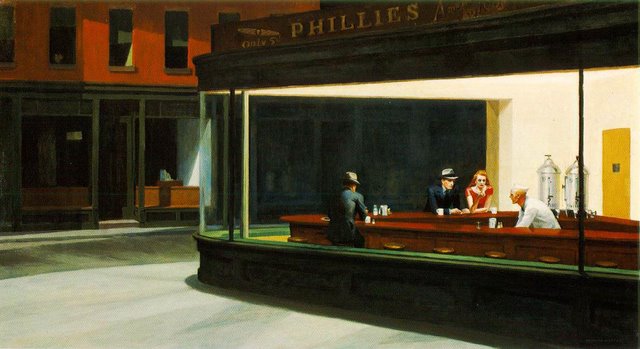
from the Poetry Challenge Nighthawkes II
Jeff and I met to discuss the final Round of the Poetry Challenge. We agreed that two poems from this round would be in the final. We will have 8 poems in the final for this challenge. Nighthawkes II was written in an hour this morning. Although it was based on lines I'd discarded when I wrote the first Nighthawkes poem that won the first round. This poem and one of Jeff's will go forward into the final.Nighthawkes
II
The empty line of the street ends here.
A glass cage café
Open onto this deserted corner.
Shrouded in blank shop facades
That dissolves in shadows.
Inside, the hard light
A shining chrome urn
Splinters the bare white walls.
Along the smooth curves of the counter
His hard hunched shoulders
Her heavy dark eyes lowered
Nameless in grey suits
and the grey blades of their trilby’s.
Predators
Among the café’s paraphernalia
And their self enclosing arms.
© David Loffman
17 November 2007
Tuesday, November 13, 2007
Handling Prayer
Hope you like it.
D
SERMON 11 NOVEMBER 2007 6.30
MATTHEW 7:7 – 12
Heavenly Father please take these words of mine and these words of yours and breathe your holy spirit upon them. Give them life to our lives and glory to you. In Jesus name
I don’t know very much about prayer. And it feels quite strange standing up here this evening in front of so many prayerful people. But what I do know I’ll share with you. I’ll share with you what I’ve learnt from the bible and from my own experiences.
A friend of mine told me the other day that Prayer is like a balloon. We fill it up with all our worries and concerns. And then we must let it go. Release it, trusting that it will reach its destination. Believe that it will come to rest in the hands of our heavenly father. We may not like the answers he gives us. They may seem hard to understand. I have made many prayers and I have often been left feeling lost and confused.
The passage we are going to look at this evening comes from The Sermon on the Mount. And perhaps the most important message for us in that sermon is that we must live lives that are different from the people around us. Jesus tells his disciples and listeners to be different from the Jews, the Romans and the Pagans around them. Every part of our lives should be different. The way we treat people and the way we talk to God should also be different.
In this passage Jesus returns to the subject of prayer. His first mention of prayer in the sermon can be found in chapter 6. In that chapter Jesus teaches his disciples to be different from the Pharisees and their hypocrisy. He calls them to be different from the empty and meaningless utterances of the Gentile’s. Jesus also gives a model or a template to his disciples for prayer in the words of The Lords’ Prayer.
In Matthew 7which Katy read to us. Jesus makes us a pretty bold promise.
He says that everyone who asks God will receive what they have asked for. [Pause / Repeat]
Jesus is concerning himself here with general prayers such as requests and prayers for help for ourselves and for others. But he urges us to keep on persisting in prayer. He illustrates his promise by comparing earthly parents to a perfect God.
He ends this part of his sermon on prayer with what has become known as The Golden Rule. This is to treat people the way we would like to be treated ourselves. In doing this Jesus says we are summing up the law and the teaching of the Prophets.
Verse 7 is the key verse in this passage on prayer.
“Ask and it will be given to you; seek and you will find; knock and the door will be opened to you.”
This simple, direct and bold promise contains some important assumptions. And it is some of these that we are going consider this evening.
The principle assumption in the passage is Faith. The confident hope that our prayers and our requests will be heard. Faith is the key that unlocks this promise. Matthew says later in his gospel “If you believe, you will receive whatever you ask for in prayer." When we pray we must pray with confidence and trust that God will hear our prayers.
This summer we went on holiday to France to visit friends. The children’s passports were out of date and I needed them renewed pretty quickly. I was full of agitation. There I was at the Post Office with three weeks to go. I paid for the check and send service and watched the cashier carefully checking each part of the application, measuring the photographs, checking signatures and declarations. Basically I did not trust the process despite his reassuring smile and beaurocratic thoroughness. Eventually the passports arrived and I could breathe easily again and sleep without waking with fear at the bottom of my stomach.
This is not how God wants us to pray. He wants us, urges us, and invites us to pray simply without fuss for what we want. And then to leave it to him. Once we have prayed we should be confident that we will be heard. We must let go of the burden of our needs. Let the balloon go.
And the reason we can have this faith is that the God we pray to is good. The God we pray to loves us perfectly. He wants to give us good gifts. It says in Psalm 103 “As a father has compassion on his children, so the LORD has compassion on those who fear him.” But God is not like a father. He is a father. He is our spiritual Father, our heavenly Father. Jesus says earlier on in the sermon “…your Father in heaven is perfect.” Think of your own father or your own children. A perfect Father doesn’t knowingly hurt his children or aim to destroy them. A perfect Father loves his children. He knows what they need most. He knows us better than we know ourselves. He wants to feed and nurture us. He wants to see us grow and mature into full people. .
Some years back I offered to drive a friend to Paris to pick up his belongings and drive him back to London over a weekend. We hired the van, checked our passports and booked our place on the ferry. I wasn’t really looking forward to this non stop, overnight trip. In passing I mentioned the trip to my father in law, who without any hesitation offered to come with me and be my co driver. Actually he didn’t have a valid passport. So when he got to London he spent a frustrating, expensive and tedious couple of days applying and waiting for his passport. Eventually he got it but in the rush he somehow lost his precious Malaya Birth Certificate. But he just let that go.
My father in law saw what I needed. I did not even need to ask. And his giving involved some personal loss and sacrifice. I think God our Father’s love is something like this. And because God is like this we can trust him.
Some translations of verse 7 and eight show that another key assumption in this verse is that we should be persistent in prayer. They use the words “Keep on asking, keep on seeking and keep on knocking.
This principle of persistent prayer is echoed and expanded in Paul’s 1st letter to the Thessalonians. It says "pray without ceasing" . Paul’s instruction to us is to pray not only persistently but also continuously.
Some years ago I came across The Jesus Prayer.
It goes like this
“Lord Jesus Christ, Son of God, have mercy on me, a sinner.”
For hundreds of years it has become fundamental part of the personal devotion of millions of Christians across the world. It is a prayer that is repeated constantly, sometimes as a meditation, and sometimes it is used by people as a pattern of thought that underpins every moment of their waking life. It is sometimes called the Prayer of the Heart because the prayer becomes as natural and as instinctive as our heart beating.
The first year I started teaching I don’t remember sleeping. I was so busy marking, preparing lessons but mostly worrying. There was one class that were a nightmare for me. I dreaded teaching them. I almost became sick thinking about them and went into each class terrified and shaking with fear. For weeks this went on. It got worse and worse. Until I thought I just could not carry on any more.
Then two things happened at the same time. Firstly I came across The Jesus Prayer and I started to repeat it to myself every morning for the whole journey to college that took about half an hour. I repeated it to myself breathing in with “Lord Jesus Christ”, then breathed out, “son of God”, followed by breathing in, “have mercy upon me”, and finally breathing out, “a sinner”.
Another kind of prayer that I used at that time that usually happened in the middle of the night when words seem so hard to dredge up out of the darkness. I began to imagine Jesus walking with me along the corridor to the classroom. I imagined him opening the door to that crowded room full of bored and insolent faces all staring at me. I imagined Jesus taking me by the hand leading me into the room. I imagined their complaints and moaning. And I imagined Jesus walking invisibly into that room and standing beside me. His eyes never leaving me, And he smiled, calmly as I began to teach.
It was the simplicity of the Jesus prayer that helped me to pray it constantly. And because I used it with my breathing I felt calmer and more relaxed. It was the picture prayer that helped give me strength confidence and authority to handle the class and to carry on every week.
This was my four O’clock in the morning prayer. And each time I prayed it I was able to sleep. Each time I prayed it the dread of that classroom shrunk.
Another key feature in handling prayer is humility. Humility is knowing our true relationship to God. And in verse 11 Jesus establishes the nature of that relationship. He says “If you, then, though you are evil, know how to give good gifts to your children, how much more will your Father in heaven give good gifts to those who ask him!”
To address God the creator, The God of Abraham, Isaac and Jacob, as father, would have been shocking to Jesus’ listeners. But with that one word - Father - Jesus introduces his disciples to a new way of perceiving God. And in doing this Jesus establishes a new relationship with God. It is no longer the remote, elaborate and public displays and rituals of prayer that are emphasised but rather the personal, private and intimate relationship between a parent and a child.
We are not insignificant to God. We are his children and we should approach him as a child calls to a father, full of hope and expectations that something good will happen.
Sometimes we feel our prayers have not been answered. Sometimes we feel we have been punished not blessed. So how can this be when Jesus has already said that whoever asks receives? To answer that I think it is helpful to consider that God knows us better than we know ourselves. Psalm 139 begins “O LORD, you have searched me and you know me. You know when I sit and when I rise; you perceive my thoughts from afar.” and later in the psalm it says “Before a word is on my tongue you know it completely, O LORD.” Sometimes we ask for things we think we need. Search for things that are harmful to us, knock at a door that can lead us to destruction. And so we are left empty, alone, with unfulfilled hopes and desires because we cannot see what God sees in us and for us. Our wills are different from his perfect will. But I do believe that our persistent and continuous prayer can connect our will to God’s will for our lives. Drawing closer to him; align our own desires with his.
This is a hard lesson and in preparing this sermon I have had to confront this difficult truth for my life.
Jesus didn’t need a big screen to get his message across on that mountain side. What he did have were words. But it is as if he had made a fire work display of his message. He must have dazzled his hearers. Shocked and disturbed them with awe and wonder. He used words so powerfully that they were imprinted on his listeners and have been passed down to us.
It was so important for Jesus to get these truths across to people. So to make a lasting impact he uses oratory techniques that are still used today by speech makers.
Firstly he uses the vivid metaphor of knocking at a door. Secondly he gives a list of three imperative verbs – ask seek knock. This repetition is emphasised by the strong rhythm of the verse. All of these techniques are an aid to memory. He uses a combination of story telling with powerful contrasts. He compares sinful people to the perfect God.
Jesus speaks in such a way because his message is so important. He wants to be as direct and simple and clear as possible.
Keep on asking and you will receive.
Finally in preparing this sermon I came across one of my favourite poems. George Herbert a poet and priest in the seventeenth century wrote that prayer is “the soul’s blood.”
So let our prayers and our lives be filled with faithful, continual and humble prayer because it is as George Herbert says the life blood of our soul.
Amen.
Saturday, November 10, 2007
One Line
10 November 2007
Saturday, November 03, 2007
Thursday, November 01, 2007
Nasrudin and the Perfect Note
Nasrudin is determined to learn the violin. He borrows one. Locks himself in a room and plays. After an hour or so he comes out, proclaims to his wife he can play, orders her to invite friends, neighbours and family to a feast. “After we eat I’ll play for them” Nasrudin says. “Don’t be ridiculous, you’ve only played for an hour in a locked room – it takes years to learn how to play the violin.” But he insists.
When the guests finished eating Nasrudin picked up the violin and began to play one long, continuous note. This went on for a few minutes, the guests began to make polite smiles, after ten minutes or so they were restless in their seats and after twenty minutes they looked at the door. After half an hour everyone had left – and Nasrudin stopped playing. His wife looked angry and so ashamed. “I have never been so humiliated, so embarrassed, in front of all our friends and family”….she was speechless. To play a violin you need pitch, intonation, pace, pauses, different notes”. “No, no no wife. All those musician’s are looking for the one perfect note, and tonight everyone heard it.” Said Nasrudin.
I told the story to a colleague of mine and he replied with this story.
Apparently James Joyce was sitting over his writing for the day. He was weeping. A friend came by and asked him what the matter was. Joyce replied that he had only written nine words the whole day. The friend consoled him saying that he would probably write more tomorrow and at least you have written something.
Joyce looked up and said something like I don't mind that its only nine words. The trouble is they are all in the wrong order.

Watch this space!
D
Tuesday, October 30, 2007
One Line
What do you think of the idea of writing one line each day or each week? I think it should be each day, actually. Just a single line. I'll let you know.
Love
David
Sunday, October 07, 2007
From The Poetry Challenge
However we have created a number of poems still in draft and we shall continue to post these to the challenge blog for a few months still to come.
Some of those will end up on this blog I expect.
Love
David
Fire Light
Through the long dark years
The victors crouch over smouldering embers
While the vast and silent shadow places,
Spread to envelop them all.
Slowly they are lulled by the fire’s warmth,
The taste of victory thick in their mouths.
While the defeated ones
Scattered to cold, distant corners,
Sit hungry huddled together for warmth,
Drag yesterday’s ashes over themselves,
Their weary limbs search
For the last traces of heat
Hunched shivering in shadows.
Thin uneasy sleep invades the watchers.
The faded embers splutter, crack
Plummet distant rock walls
Stirs vague incoherent dreams
Of the dredged and dreaded, black leafed forest.
And the fire light flickers on
Bright incandescent filaments dance
Always shifting in the stale breeze
That drifts through the stone chambers
Deep down at the fire’s roots.
It is there in the fire’s deep
With fear stalking the darkness
Our waking dreams were born.
© David Loffman
07 October 2007
Saturday, September 22, 2007
Pale Blue Dot (Revised Again)
D
Pale Blue Dot
‘Earth is the right place for love’
Robert Frost
Four billion miles out
On the edge.
A camera turns
Refocuses robotic lenses
On this dust mote afloat
In a beam of distant sunlight.
Held by a solar thread
Remote and alone
Shrouded in giant darkness.
A self-portrait.
This speck of fertile rock
Like a grain of sand
Suspended in cosmic sea
The fragile petals
Of a wild flower, slowly unfurling.
No one is coming.
It is up to us.
© David Loffman
Thursday, September 20, 2007
The Earth from the Dark Side of Saturn
Here is another photograph taken from the outer Solar System.To the left just beyond the bright inner rings is a faint blue dot at about 10 O'clock.
The dot is Earth.
Sunday, September 16, 2007
Pale Blue Dot

Pale Blue Dot Four billion miles out
On the edge.
A camera turns
In deep space to face home.
Refocus robotic lenses
On this dust mote floating
In a beam of distant sunlight, drifting.
Remote and alone
Shrouded in giant darkness.
This speck of rock
Like a grain of sand
Suspended in a cosmic sea
Is home.
No one is coming to rescue us.
It is up to us.
© David Loffman
16 September 2007
http://en.wikipedia.org/wiki/Pale_blue_dot
Monday, August 27, 2007
Handling Anger
And after preaching last night he has asked me to join the team.
SERMON 26 AUGUST 6.30
Handling Anger
Lord God Please take these words of mine and these words of yours and breath your holy spirit on them. Give them life in our lives and glory to you. Amen.
I have a problem handling anger. We were driving back from France last week. We had been on the road for ten hours; it was eleven thirty at night and we were desperate to get home. We finally made it to the M25 but when we were approaching our exit the motorway was closed and to my horror we were diverted on to the M23 towards Gatwick Airport. I was furious. I was really angry. We got home two hours later than we expected.
Over the last few weeks we’ve been looking at the Sermon on the Mount, and the main reading that Trevor read to us is part of that. Throughout the Sermon Jesus wanted his disciples and us to live righteous lives. He wants people to be salt and light in the world. For that first audience it meant don’t be like the Scribes and Pharisees - who reduced the law to a series of prohibitions and observances. And we shouldn’t be like the materialistic world around us. Yes Jesus wants his audiences to do what the law commands but he wants our hearts and minds tuned into the law as well.
In verse 20 Jesus says “unless your righteousness surpasses that of the Pharisees and the teachers of the law, you will certainly not enter the kingdom of heaven.”
In the Sermon on the Mount Jesus sets out to show how we can live righteous lives. Jesus takes the ten commandments as his starting point. And offers practical ways of living by them. From verse 21 – 48 he comments on the commandments, he breathes new life into them, revitalising them making them come alive.
This evening we’re going to look at verses 21 – 26 Jesus’ where Jesus comments on the sixth commandment “You shall not murder.”
In these verses
· Jesus says that anger and insults towards a sister or brother is equal to murder.
· Jesus says to be angry with a brother or sister puts you in danger of the fire of hell
· Anger is an obstacle to worship.
· Therefore be reconciled to our brother’s and sisters.
· Do this quickly
· So that you can return to true worship and living a righteous life.
In verses 21 – 23 Jesus says anger and insults are just as bad as murder.
He says “anyone who is angry with his brother or sister will be subject to judgement”. Here Jesus talks about the anger that comes from a desire to get rid of somebody; somebody who stands in our way. And that for Jesus is murder. It’s an anger the spills into insults and abuse. It’s an unrighteous anger motivated by hatred, malice and revenge.
Hamlet is a play dominated by revenge. In it we are given a portrait of a revenge hero from ancient Greece. Pyrrrhus – a man seeking revenge for the murder of his father at any cost physical or spiritual.
'The rugged Pyrrhus,,Black as his purpose, did the night resembleSmeared with blood of fathers, mothers, daughters, sons,roasted in wrath and fire,And thus o'er-sized with coagulate gore,With eyes like carbuncles, the hellish PyrrhusOld grandsire Priam seeks.'
Recently I’ve had some difficulties with a neighbour over parking. I didn’t know what I’d done to upset him. He became quite rude. Every time he saw me he’d swear at me. I tried to talk to him about it but he wouldn’t listen. As a result it was me that became angry. Every time I drove home I thought about him. I was like the person in
1 John 2:1 1 where he says “ whoever hates his brother is in the darkness and walks around in the darkness; he does not know where he is going, because the darkness has blinded him”. More about my neighbour later.
Hatred changes the way we live. It changes the way we behave towards people. It can turn our work places and homes into battlegrounds. Jesus says the issue of anger towards people is so important that it excludes us from the Kingdom of God. 1 John 3:15 says Anyone who hates his brother is a murderer and you know that no murderer has eternal life in him.
Have you ever been so angry that you have almost lost control? Which is one reason why Jesus wanted any angry disputes solved as quickly as possible. Jesus wanted a nation united so that all their energies could be devoted to living righteous lives, worshipping in truth and purity of spirit. Jesus wanted his listeners to be a light to the world.
But conflicts were common is Jesus’ day. He lived at a time when the Jewish nation was under great pressure. Any country that is occupied by a military force is under stress. People feel fragile, insecure and vulnerable. Under these conditions it is no wonder that conflicts develop.
Also Israel in Jesus’ time was a highly structured and segregated society. And this too can be a cause of arguments. A Roman soldier insults a Jew, a Samaritan attacks a Jewish neighbour, and a Jew fights back. And within the Jewish community there were many different factions.
Is our society so different?
Okay we are not under military dictatorship but many of us live under huge amounts of pressure. Often we are stretched to the limits of our resources. Our neighbourhoods and our homes can become a breeding ground of anger, resentment and hatred. The newspaper headlines this weekend are full of gang culture and gun violence. To Jesus, when we are angry at someone its just as bad as if we were using a gun. For the LORD looks at the heart.
And this makes our worship meaningless. So we need to acknowledge our anger and tackle it. Jesus says a breach in the relations between people makes their worship fit for the rubbish dump.
In verse 24 those who use insulting language “will be in danger of the fire of hell”. The word “hell” is a translation of the word “gehenna”. To Jesus’ first audience it is a word that they understood. It is mentioned throughout the gospels. In the Old Testament it is a deep and narrow ravine just beyond the southwestern walls of Jerusalem. It was a cursed place. It was a place where the rubbish of the city was burned, where the bodies of executed criminals were dumped and where the Canaanites sacrificed children to their God by burning.
Our worship must be without blemish or fault.
It says in Leviticus 22:21 “When anyone brings from the herd or flock - traditionally a peace offering to the LORD - it must be without defect or blemish to be acceptable”.
But Jesus wants more than just the physical details of our worship to be right. He wants every aspect of our worship to be perfect. Our whole lives are to be a living sacrifice. When we have hurt someone Jesus says we should even interrupt our worship and be reconciled to the one we have hurt.
Imagine for a moment what that would have entailed to one of Jesus’ listeners. The penitent and the priest both have their hands on the sacrifice at the alter of the temple in Jerusalem. And the penitent is just about to say these words “I entreat, O Lord; I have rebelled… but I return in penitence and let this animal be for my covering” ……………. when he suddenly remembers somebody he has hurt. He lets go of the animal walks back along the long queue of penitents, to the three-day journey back to his village in Galilee. Where he finally knocks on a neighbour’s door and humbly asks for forgiveness for the wrong he has caused him. Then he turns round and looks down the road and the three-day journey back to the temple and wonders if the priest is still holding the goat he had brought.
Jesus’ solution to the breach in relationships is much simpler. And that is reconciliation, now.
Making peace involves being sensitive to the people in our lives.
It involves letting go of our self-centredness. It’s about being aware of how we affect others. Making peace involves a genuine and humble attitude to God, the people we come into contact with and our worship. It is an on going process; we must attend to it daily. We need to adopt an attitude where we are prepared to change, to admit the pain we cause others and move on.
This happened to me once years ago here at Christ Church just before a Communion service. A friend came up to me. He took me aside and asked for my forgiveness. Actually I didn’t know what wrong he had committed against me but his face was so pained and awkward so I said I forgive you. Then he hugged me and we returned to our seats. He did not want anything to come between himself and God or between God and me. He wanted our worship to be perfect.
Reconciliation is hard. It involves a denial of our pride and our ego. It’s a sacrifice of the heart. It says in Psalm 51 “The sacrifices of God are a broken spirit, a broken and contrite heart.” That could not have been an easy thing for my friend to come up to me. He had made himself vulnerable and weak. But he did it anyway.
In Mathew 5:21-26 Jesus’ examples of anger and insults between people show us that God sees our anger as if we were killing someone. Whenever we are aware of the hurt we have caused others we should make peace with them as soon as possible. Without reconciliation our worship is meaningless.
And so now, back to my neighbour and our parking problems. Late one night I met him walking his dog. A few hours earlier he was swearing at me as usual. And then he came over to me and said, “I’ve had enough of all this,” and offered me his hand. And since then we’ve been fine. It seemed as if his anger was a burden to him as well as it had been for me.
Jesus is telling his listeners not to let anger take hold of our lives. Anger locks and shackles us to the world. It keeps us prisoner. In it we can barely see heaven. We should stop it before it affects our worship and our relationships with other people.
We should Be perfect, therefore just as our heavenly Father is perfect.
Tuesday, July 17, 2007
for the Poetry Challenge and At The Troubadour
When I read the opening a few weeks back to Katy she went Yuk! So I knew I was on the right track. The poem was written as part of the poetry challenge and is part of a series of poems on Intruders.
The theme of The Troubadour evening was Home. It can be a subject that cloaks the past and often pain in soft focus. It can inspire sentimental nostalgia.
I think I wanted something raw and uncomfortable.
Kitchen Intruders
Behind the sink
A crack in the splash back
Opened up black wet, cavernous.
A dark damp nursery
Of slime coagulating
In dank glutinous blindness
Blistered with slugs
Suckling in musty darkness.
Each morning
A faint trace
Of their slow scavenge
Across the floor.
Paths crisscrossing
Like the lines of aeroplane vapour trails.
Each night
We gave the house over to them
To feast on our remains.
© David Loffman
Sunday, July 01, 2007
R.E.M. - Everybody Hurts
This is a bit of a test. Hope it works. And hope you enjoy the poem and the video. One thing that strikes me about the video is how it borrows quite consciously from Wim Wenders' Wings of Desire.
Anyway - the poem
Stationary
Lonely motorway
Asphalt and aggregate
A long congested tail of vehicles
Convulses to a stop.
A clock on the dashboard
Measures lost miles
As the minutes pass.
Stasis shrivels meaning,
Swallows belief.
Speed is the highway’s only currency.
Blurred lines its only vision
Visible only in movement.
Thoughts are stretched thin
Try to focus
Will dissolves
Eyes glaze
Vague distractions fail
The radio and cross words.
The anchor drags
At a motorway interchange
Layered bridges
Unscalable parapets
Debris in the gutter.
Buckled and rusted hubcaps and beer cans.
We are the discarded,
The forgotten,
On this obscene stationary carriageway
We wait, heavy on processed air.
But in that restless hypnotic emptiness
Drowsing with boredom and shame
A driver seems to rise like an Angel
Unfold himself
Crosses lanes
To the central reservation.
Arms outstretched
Like a messiah of the motorway
A sentinel on the parapets
Offers a benediction to the stranded.
Calls to us out to follow
Like a Pied Piper.
© David Loffman
30 June 2007
Sunday, June 24, 2007
from The Poetry Challenge

Royal vines
Sunday, June 03, 2007
from The Poetry Challenge
Sorry it has been so long since my last post - 3 weeks I think.
Jeff and I have had a short break posting poems to each other. But now we are back to it. I'm hoping now that most of the teaching is finished to spend more time working on the poems and the challenge. They have been neglected since February. So maybe you will begin to read poems with a broader vision and better worked.
The poem below is part of a series of poems based on paintings I have stumbled across. Other poems include Hopper's Night Hawkes and Van Gogh's Night Cafe. These poems have been posted to this site.
Hope you enjoy the poem.
Love David

Portrait
from L’ absinthe by Degas
She sits slumped
Like an old paper bag
That the wind had blown in
Crumpled and wrinkled.
She wears defeat
In her stained faded white bodice.
She has retreated here.
To this bench
With this man,
Beside this cold marble table.
Behind her - the white washed walls
Where pale shabby curtains fall
Against the dead white light of the sun.
There is surrender
In every part of her appearance.
There, in her dull watery eyes
That cannot focus.
There, in the tired cotton frills
That hangs slack around her neck,
Yellow ribbons cling like wilted flowers.
There, in her shoulders and arms
That drop limp and loose.
They carry the heavy failures of her life
That she dissolves
Into the glass that rests beside her.
Her head tilts against the cold
And painful morning light
And he is all in brown.
Crushes her in that hard
Battened down indifferent look –
Seared by the pain of a thousand failures.
© David Loffman
03 June 2007
Monday, May 07, 2007
from The Poetry Challenge
I
Watching Jack
Saturday morning
Quiet cul-de-sac.
The street basks in spot light sun
And Jack takes his dog for a walk,
Passes in front of us
Sitting behind the wide window screen
Relaxed for a moment
Before the children return.
The street, a slow unravelling
A random and effortless soap opera.
Jack passes by on the other side
He’s eighty, his dog, Alsatian,
Young, gangly and alert
On the lead – their daily exercise.
Then Black Harry comes across the road
At Jack’s dog
Barking and jumping up at his throat
There is the roar of dogs
And Jack shouts
Pulls at the lead
Then bends down
To put his arms around his dog.
When we get there
We don’t know what to do.
Jack won’t let his dog go
Harry is all jaws and saliva
His teeth around the Alsatian’s neck.
So I grab at Black Labrador Harry’s collar
Pull him straight off Jack’s dog.
He comes away easy
His anger retreats
With adult authority
Then seems disinterested
When his owner comes
To grab him off me.
She was in the back garden
Her mate in the shower
Harry must have slipped out unnoticed, she says.
So there’s Jack now
Shouting at her
He’s losing his breath
But he keeps on yelling
He changes colour.
We try and calm him
But he takes a few steps into a driveway
To get some distance from us
Pulls his dog with him.
Then he stumbles onto his knees
And crumples onto the ground.
Lies there, motionless,
Accusation and anger in his stare
With his face turning blue.
That was the last we saw of Black Harry
And Jack, stretchered into an ambulance
The driver shaking his head.
© David Loffman
Saturday, April 14, 2007
from The First Poetry Challenge
The photograph was taken last Tuesday 10 April with our friends in their wood in Kent.
The poem was written on a visit to the wood in 2000. Hope you like them both.
Moment in the Wood
I first heard the wind
blowing far off trees.
A hushed restlessness
that could have been rain.
Then granite grained
light dissolving fast,
sun cloaked.
The wind, louder now,
metallic sounding.
Could have been
farm machinery.
Suddenly tree tops
convulsed wildly,
branches flung helpless
crisp leaves hissing
like radio static.
Now here upon us
flapping tarpaulin
smoke scattering
all over the camp,
bushes and branches
bent to knotted brambles
and the heat swallowed
up by sudden chill.
Then the wind running
off to somewhere else
leaves, everything, still.
Wind came, stopped our work,
like unwanted thoughts,
disturbed our peace,
like a door slammed
against the summer.
© David Loffman
Sunday, March 25, 2007
A Speech in the Members' Dinning Room
On Wednesday March 14 there were many great speeches in the Palace of Westminster. The Commons were debating Trident - there was a water cannon on College Green. The Lord's were debating their own extinction. And in the Members' Dinning Room at 4.30 I got up to address and audience of Royality, Lord's and Ladies, Ministers, Members of Parliament, an assortment of minor celebrities and many disabled students who had just been given a grant by The Snowdon Award Scheme - a charity that helps disabled people back into education.
This is what I said.
Lord Snowdon
Lords
Ladies and Gentleman
It’s really great to be here today and speak with so many people that have recently started such a varied and diverse range of courses of study. It is exciting being with people making a new start and making positive changes, a new beginning. It’s so positive and life affirming. Though I expect with your excitement there are doubts and fears.
But so many people here have struggled and overcome so much already.
Here is a bit of my story. I hope it will be an encouragement.
I left school at 16 in 1975 with no qualifications at all. I remember walking out of the school gates for the last time with a huge smile on my face and victoriously telling myself that I would never open the door of education again.
However I returned to full time education just two years later. I was recovering from a serious illness and when I went back it was to a further education college. There I started an academic journey that has redefined and changed my life completely.
At first I didn’t know what I could do so I enrolled on a basic pre O level vocational course. At the end -clutching a handful of credits and distinctions - I asked my lecturers well what should I do now – and they replied, why not try some O Level’s. And when I’d completed those I looked around wide-eyed with a beaming smile and asked again – what should I do now. Another lecturer answered well why not try some A Levels now David.
As I was completing the first year of A Levels – everyone around me seemed obsessed with universities and application forms. I had some struggles with the recurring disease but I asked again what shall I do after this. and one of the lecturers said rather impatiently I thought – you should try a degree. And so I did.
I was the first person in my family to study for a degree. It meant leaving home. It meant setting up a life independent of my family. It meant spending money my parents did not really have. And more scarily It meant taking my own responsibility for managing the disease and the damage it had left by myself.
But there seemingly out of the blue – suddenly – there was the Snowdon Award Scheme. It gave me an award that helped me be independent in those first tentative steps away from home - studying, buying books, fares back home for hospital appointments, and desperately trying to buy food that I could make into something edible.
[It was a difficult first term. And I remember sitting in a student bar on a cold January evening in the ruins of my first university relationship. I was surrounded by fit and healthy people that could party all night and walk without thinking about it. I felt that I wanted to go home. I wanted to stop and start the degree again. But I didn’t. I couldn’t.]
One night very very late we were sitting in my room drinking port and listening to David Bowie. A good friend said to me I’d make a good teacher. And I immediately thought of the Further Education. What they had given me, I could give to others: a second chance at education and the enthusiasm and wonder of learning.
And so when I completed my degree I went on to train to be a lecturer in Further Education. and that is what I have been for the last twenty years a: a lecturer in Further Education And sometimes I teach on that same basic vocational course that I first studied back in 1977. Along with becoming married, raising children, I also write a ridiculous amount of poetry – some of which is about illness and recovery.
Finally. I remember being sent an invitation to what must have been the first Snowdon Award Ceremony back in 1981. And I remember very clearly declining to attend. I remember I felt quite awkward, clumsy and very shy. I think I felt overawed and out of place.
So it is quite ironic really that 25 years later I would be given this rather wonderful and public opportunity to say thank you to Lord Snowdon, the supporters, sponsors and all the people working behind the scenes at the Snowdon Award Scheme.
And great also to have this opportunity to wish you success and satisfaction in all the diverse courses you are undertaking.
Thank you.
It was great fun.
Thursday, March 15, 2007
from The Poetry Challenge
We stayed up late
through winter nights
long before you both came,
and played with names
conjuring you out from the darkness,
drawing you into our lives.
We lulled each other to sleep
with you on our lips.
We spoke them to each other,
surprised ourselves with their strength
and strangeness,
tried to catch ourselves
off balance with them.
We collected names
like given clothes
for a bottom draw.
Sometimes we’d take them out
when no one was listening
and try them on.
We savoured them on our tongues
and sounded them for size and fit.
At first all we had of you
were your names.
We covered you both
in long soft vowels
and granite consonants
years before you arrived.
© David Loffman
Saturday, February 24, 2007
The Third Round

Jeff and I met today to read our second round poems to each other and vote on the best poem for the round. It was a great afternoon despite the blustery rain and wind on the South Bank. We sat outside to read and drew on the help of two waiters to help choose the best poem of the round.
by Jeffrey Loffman
Prompted by J.M.W. Turner’s ‘Fishermen At Sea’
The open boat slaloms across the mounting wave
Crash upon crash against starb’rd
Hanging on to masts and fixed boxes
Showered awash and swathed in fear
We cling on – our faces blinded by wash
Our noses full of fish piles in baskets
Fins flapping like sails wrapped by storm
As full moon occasionally glints between black sky
Winds whip around and, distantly, a thunder burst
Far from home we are told to keep nets out
And the boat is beaten and pummelled
Will we see the dawn rise? hear gulls scream?
All we can hear is the roll bellow of towering sea
All we can feel is sodden and still soaking
All our clothes drip under our waterproofs
All on the North Sea angling for our future
Our well-being, praying to dock and beach
See lights on the shore, see home again.
And here is a poem from me that Jeff rather liked.
Music Box
Even nowthirty-seven years later
I’m still unwrapping
the gifts inside
the music box
he bought for us
one quiet Christmas morning.
And still I plunge my hand
into that darkness
and pull out the music
still hidden deep inside.
Music now so far from him
it lies out of his reach
an unfamiliar language.
But I remember
long lost Sunday mornings,
sitting at the dinning table
in his vest,
his soft voice rising
while his hands tapped out
the beat from an old biscuit tin.
And I can still hear
those first songs
strong and clear,
and see in his blue eyes
“a bright golden haze on the meadow”
the “cattle standing like statues”
and an old river of sound
flowing out through the years.
© David Loffman
I hope you like the poems
David
Sunday, February 11, 2007
A Short Break
We have come to the end of the second round of the poetry challenge. The third round starts on the 24 February. Until then I'm building up draft poems so that I have a good number that have been worked on for some weeks. It's slow work at the moment. So much is going on at home and at work as usual.
Jeff seems to have all his poems written for the entire challenge - right up until November - so he seems well ahead of me. He will spend these months editing his poems.
Although I have over thirty poems in draft I only have a handful of drafts at the moment that have been worked on enough to become finished poems. I generally choose a draft from the draft pool and work on it over a period of weeks or months before I post it to the challenge blog. At any one time I'm working on about 5 or six drafts.
The week after next is the half term holiday and at the end of that week Jeff and I meet to choose the best poem of the second round and we start posting again.
Hope you enjoy the posts.
I'll try and post to this blog every two weeks with a poem.
Take care
David
Saturday, January 20, 2007
from The Poetry Challenge Quiraing

Quiraing
for Pam and Simon
Trotternish escarpment
still slow landslip
to the sea.
We came this way
low and long
along the Trotternish ridge
that towered beside us
and the steep fall to Raasay Sound below.
We walked that rough track
one late October
where we fought the wind
wrestled the cold, breathless
with thick clotted cloud
scouring the sky
picking the bones
of the exposed land.
We hardly spoke
in that roar and twist of the air
that tore into us,
picked us clean.
I waited at The Saddle
where the wind rose to meet me from both sides
wind bitten, hands numbed
as I clutched at the hard neck of rock
like riding the rock fall deep,
plunging long into the sea far below.
And watched the distant Torridon Hills
glowing red in the growing dusk
beyond the far Inner Sound.
© David Loffman
20 January 2007
Thursday, January 04, 2007
from The Poetry Challenge The Samurai Sunset
2006 was a difficult year in lots of ways but I think 2007 should be more straightforward. We are still settling in and adjusting to the major disruptions of 2004/5, as well as coping with new challenges at work and with the children.
Any way here is a poem from the poetry challenge which is going well I think. The poem comes out of some of the stresses and tensions brought about by 2004/5 changes.
Hope you like it.
Happy New Year!
Love
David
The Samurai Sunset
I brought you back this glass plate.
A peace offering,
that came with its own light,
as red as a hard pulsating bruise.
Translucent.
The colour of blood
skeletal shadows
inhabit its depths.
Deep magenta
too dark to fathom
a flame too hot to touch.
Incendiary,
incandescent magma spill
to cauterise the wound.
In the gallery where I found it
they framed the Samurai Sunset
with smooth glass pieces
soothing curves
pale shimmering lights
soft undulating lines
of green blue sea surge
and aqua-dark cyan.
I bought it for you.
It spoke my rage for me
transformed it into something of beauty.
© David Loffman
29 December 2006
Tuesday, December 19, 2006
from The Poetry Challenge A Bunch of Flowers and a Packet of Condoms
So here are a couple of very recent poems from the challenge. One friend commented on, A Bunch of Flowers and a Packet of Condoms, saying it was the best poem she had seen from the challenge so far. I'm not so sure its even a poem.
These two poems are a short sequence and were written together.
Hope you like them.
Happy Christmas
A Bunch of Flowers and a Packet of Condoms
That first time at the checkout
he was pissed.
A basket full of condoms, Stella and Whiskey
and his mates
wildly pushing their way
to the front of the queue
shouting slurred and angry at everything.
But her eyes
filled the numbed wreckage
of his thoughts.
When he was outside
he looked back at her
through the big windows.
The second time
just the paper and fags.
Alone he waited –quietly
and choked out a thank you
as she dropped the change into his hand.
The third time he chose more carefully.
Baked beans and a microwave meal for one,
she made her customer smile
but he didn’t believe it.
He thought there was more.
So he came back the next day to check.
Bought chocolates and offered her one.
He said something about the weather
then wished he’d said nothing
as she moved on to the next one.
Once he thought he saw her in Woolworth’s
and he followed her for a while.
Then he came in at the weekend.
Casual, jeans, clean T shirt
The store filled with families
and their juggernaut trolleys, overflowing.
In his basket, CD’s The Kooks and Kaiser Chiefs.
He was serious,
and worried that she was Rap and R & B.
On Tuesday he filled the basket with fruit.
Stuff he’d never eat.
Large Medjool dates, ripe mangos
and small fur green looking eggs
he didn’t know the name of.
But the smell was sweet and rich
as he watched her carefully weigh
and price each one.
He thought about her
with the fruit in a bowl
while he drew a mango to his lips.
He thought about her at work
and driving home.
He thought about her in the pub on Saturday night
with his mates
and Sunday morning in the shower.
On Friday he thought about her
in the long agonizing queue.
In his basket,
red roses, the chocolates
and a packet of condoms
and when he faced her
and looked into those eyes
that seemed to swallow him whole.
He said, “these are for you,
what time do you finish here?”
© David Loffman
I Carry A Knife Now
“Once he thought he saw her in Woolworth’s
and he followed her for a while.”
Afterwards I never felt safe. Never!
Even though I moved away.
I ain’t stupid!
I always keep it with me.
Safe!
Lates is worse!
Though I still wake nights
screaming, tears in me eyes.
No one knows me here
though I’m always lookin over me shoulder.
I can’t be sure.
Like yesterday, lunch.
I’m in Woolworth’s and I see this face.
He looks familiar.
He clocks me.
Can’t place him though.
Looks a’right s’pose.
But I can’t be sure
so I try and lose him.
But he’s following.
And I lose me breath
and I’m all hot n cold
and me heart’s like thumpin hard.
Fuck! I think
and I run out the store.
Razor must ave sent him.
Dunno ow e found me.
When I get back I just wanna leave.
I’m not hangin round here.
I tell Janice, the superviser.
She says if I leave on Saturday
she’ll pay me the week
which is good cos of the rent and stuff.
But I can’t wait.
Maybe I’ll just go.
I’m like so scared.
© David Loffman
Sunday, November 26, 2006
from The Poetry Challenge Treasure
Arran played the hardest game of football he has ever played yesterday. He was cold, wet and muddy, he felt really low and his team let him down badly I think. But he made a real job of being in goal. He stuck it out. He dived hard into the mud again and again and saved many difficult shots.
I was so proud of him.
Anyway I hope you like the poem.
Treasure
Drive them to a mountain stream
Drive them to a rocky beach
Bring them to a mountain path
Bring them to a white sandy beach.
Give them thirteen hours
in the back seat of the car
with a book, a pillow and a toy monkey.
Give them a steamed up window
to play noughts and crosses on.
Bring them a two-hour traffic jam
diverted at midnight on the M6.
Show them a couple of sheep in a field.
Show them a sparrow,
a shipwreck and a standing stone.
Bring them biscuits for breakfast,
hot chocolate for lunch
and chips for dinner.
Show them grey skies
and a thin seam of silver light
stretching over a Loch.
Show them swallows at dusk.
There are eagles in the hills.
Make them sleep in a broken tent
with three inches of water
at the bottom.
Tell them this is a holiday
Leave them on a rain-drenched beach
for two hours
until their hands and toes turn blue.
Tell them it will be better tomorrow.
Buy them fishing nets and a football.
Make them set up camp
three times in four days
in hard wind driven rain.
Don’t let them see you cry.
Show them flowering Lichen
Orchids, Rock Rose,
Cotton Grass and Heather.
Let them drink mountain water
from Sphagnum Moss.
Show them a rainbow
stretched across the island
we are leaving.
And watch a light
shine from their wind weary faces.
And watch their smiles lift you higher
than all the rain grey clouds.
© David Loffman
Saturday, November 11, 2006
Upgrade
One advantage of this is I've been able to add Links to the blog - something I've been trying to do for a while and now I've done it.
Over the next few weeks or months there will be some changes and I hope the blog will look more personal.
Watch this space.
David
Thursday, November 09, 2006
from The Poetry Challenge Hearing 'The Thought Fox on the Radio'
I wrote this poem last winter. I was asked to read at The Troubadour one animal poem no more than 25 lines and there was a week to go and I still did not have a poem. So I thought I'd read Hughes poem about the thought fox.
I was driving back late from somewhere and I put the radio on and suddenly there it was, Hughes larger than life reading the poem. And I knew I could not read it.
The next morning we were driving down to Guildford and out of the corner of my eye I saw a dead fox in the gutter of the A3. It was then I knew I had a poem at last.
At the reading, Hugh Epstein and me did a double act, he agreed to read The Thought Fox by way of an introduction to mine that followed straight after.
Ted Hughes's poem first then mine
The Thought Fox
I imagine this midnight moment's forest:
Something else is alive
Besides the clock's loneliness
And this blank page where my fingers move.
Through the window I see no star:
Something more near
Though deeper within darkness
Is entering the loneliness:
Cold, delicately as the dark snow,
A fox's nose touches twig, leaf;
Two eyes serve a movement, that now
And again now, and now, and now
Sets neat prints into the snow
Between trees, and warily a lame
Shadow lags by stump and in hollow
Of a body that is bold to come
Across clearings, an eye,
A widening deepening greenness,
Brilliantly, concentratedly,
Coming about its own business
Till, with sudden sharp hot stink of fox
It enters the dark hole of the head.
The windowis starless still; the clock ticks,
The page is printed.
and my poem
Hearing “The Thought Fox” on the Radio
Midnight. Winter darkness.
I drove home
through lonely silent suburbs.
Frost gathered –
formed a white lining
in the streets.
Then the hard dark grain
of Hughes’s voice
burst into the car
conjuring his midnight fox
so loud I thought he sat beside me
haloed in neon and moonlight –
the creature hidden
in the folds of his coat.
Later, in the road
among fallen leaves and branches -
a dead fox
rolled up like a discarded carpet
rust coloured
slumped in a gutter.
The insistent reach
of Hughes’s voice still
shadows me
now, as I write.
© David Loffman
11 December 2005
Thursday, October 26, 2006
from The Poetry Challenge Nighthawkes


Nighthawkes
In the late night diner
they perch on bar stools
leaning forward
hunched against
the vast seamless window
that frames them.
In the darkness
hard fluorescent light
bares them blind
to the deserted streets.
They wandered in
on a troubled night.
To pick at the bones
of their marriage,
savaging the reaches
of their revenge,
in this mime of misery,
where there is no escape
and the coffee offers
only stinging bitterness.
They sit in the empty yellow
glare of spotlights
on this sprawling midnight canvas
that spreads its wings
and submerges us all.
© David Loffman
21 October 2006
Monday, September 25, 2006
from The Poetry Challenge The Bell of All Hallow's
The Bell Of All Hallow’s
Each morning
during the summer term
with all the classroom windows open
and the wind in the right direction,
the bells of All Hallow’s
comes to us
like a solemn whisper
a hushed promise -
its faint chimes
ripple out over the town.
They come to us
a gentle gift -
a wave that flows
above the low drone
of pre motorway traffic
and over the hard
lines of the roads.
Between our words
a soft peal drops -
sky music.
A quivering island of sound
blown by the wind
reaches out over the suburbs
calling to us
as pleasing as a tuning fork
resonating to the bone.
© David Loffman
25 September 2006
Friday, September 15, 2006
The end of the One Hundred Word Project
The poetry challenge started three weeks ago and the challenge is due to end at Christmas 2008. I intend to post my challenge poems to this blog on a regular basis -not always once a week. The occasional One Hundred Words will slip through and the usual book, film and I also intend to post Poem Reviews will also be posted. I also hope to make more use of photographs - my own and those on the net.
Watch this space!
Wednesday, September 06, 2006
One Hundred Words About Summer's End
Our lives have come back to us with a sudden rush of activity. So much is happening around us it is hard to keep track of everything. The children have started their different secondary schools. And seem to be settling in. They are managing their very different school journeys, meeting new friends and keeping contact with older ones.
Katy and me are settling into our own new routines.
Katy is establishing her freelance work, she has been writing and talking to potential clients and these contacts really seem positive. She is so much happier when she is plunged deep in the middle of work – the difficulty is establishing the right balance.


